I got advice in my inbox this past week on how to have a successful sabbatical. It came a few months too late, but still, thought I, there may be something I could learn from it.
Apply for visas and work permits early, it suggested. Check that one off! Look into tax laws. Get your family prepared. Check and check! Finish off all your old research projects before you leave, to have a clean plate while on sabbatical, to devote to brand new projects!
Frankly, one of the major work-related goals I had for this sabbatical was to use large chunks of uninterrupted time to finally finish some of the ongoing research projects I have. If I did nothing besides finish projects, I would call my sabbatical as a success.
So how has it gone so far, you ask?
Well, in the first three months of my sabbatical, I wrote solid drafts of four papers. These I passed along to coauthors, letting them know I was happy, and all we needed was their approval before sending them off into the wide world!
Meanwhile, I had started a really great project here with a colleague. We had an idea, and within the first three months of my arrival we had made amazing outstanding wonderful progress. And then, we had awesome results! The kind of results that would get me a very strong publication, a promotion, grants, fame, fortune, movie contract! (Well, maybe not a movie contract, but still....) We started writing up our results, and told a few people about how exciting they were going to be.
Best sabbatical ever. All within the first three months!
At the beginning of the fourth month, I found a hole in one of the projects I was about to speak about at a conference. I realized it wasn't actually correct as we had thought. I spoke on something else.
At that same conference, when it was over, and I was trying to get other work done, I realized that there was actually a problem with the new project. Upon further investigation, the amazing outstanding wonderful awesome result fell apart completely. So much for fame and fortune.
Coauthors began writing back. There were issues here and there in the other papers, too, that needed to be fixed and thought through.
And now, with 70% of the sabbatical finished, I find myself still working on the same collection of projects that I began with. All in various stages of disrepair.
I will probably fix them up. The first hole in the first project has been patched, for example. Another hole in another project has also been patched, and the corresponding paper will probably be finished this week. The amazing outstanding wonderful project is also ongoing, and my collaborator and I continue to discover interesting stuff, stuff that will eventually become another research paper (the currency of the research part of my job). It just won't lead so swiftly to fame and fortune.
Am I disappointed? A little. But I've been in this job long enough that I know this is the way research works. I just wish it didn't work this way on my sabbatical. I liked the first three months better.
Sunday, May 25, 2014

Sunday, May 18, 2014
A week of normal days
In fragment sentences, mostly.
Sunday night charades.
Monday night Pictionary. (Seriously, that's a fox?! How did you guess that?)
Early morning jogs in the park. Full moon to the west. Red sunrise to the east. Sound of a kookaburra echoing from the south. And hundreds of dogs with their owners out for their morning sniff.
Daily chores. Making lunches. Cutting apples. Spreading sandwiches. Pears. Tomatoes.
Laundry. Laundry. Laundry. Laundry. Laundry.
Laundry.
Work. Pentagons and hexagons. Twelve pentagons. Twenty hexagons. Or more. One plus the square root of twenty-one. 5.72. 5.75. 5.77... Maybe. The answer to the question on volume is in the back of a paper from 2010. Where does the day go?
Commute. Up and down the Saint Kilda Road. Wait for the green light. Tram. Touch on. Book.
Dinner time. Again. Shopping. Again.
Queen Victoria Market. Apples. Pears. Extra large bag of oranges. That's right -- winter is citrus season! The house smells of oranges. And Christmas. Christmas smells like oranges.
Last week's cold snap makes this week feel like a heat wave. Sunshine. Twenty-two degrees -- Celsius! But don't lose the habit of closing the bathroom door.
Saturday art. This time, the European and Asian halls in the National Gallery of Victoria. Dinner out. Jonathan's choice. Ramen again? Off to wait at the Little Ramen Bar. Always a wait there. Three Ramune drinks with dinner.
Sunday church. Inner turmoil. Sunday night Pictionary. (How did you know that was a mop?!)
Reading time.
Bed time.
Repeat.
In the office in our apartment is a wall full of books, left by the owner. On the wall was a book I borrowed to read on the tram. In the book, in a chapter heading, was a quote that reads like a poem, and resonates.
“Normal day, let me be aware of the treasure you are. Let me learn from you, love you, bless you before you depart. Let me not pass you by in quest of some rare and perfect tomorrow. Let me hold you while I may, for it may not always be so. One day I shall dig my nails into the earth, or bury my face in the pillow, or stretch myself taut, or raise my hands to the sky and want, more than all the world, your return.” -- Mary Jean IrionA week of normal days. A great blessing.
Sunday, May 11, 2014
Mothers' day
In England, Mothering Sunday is in March. But in Australia, which continues its pattern of seeming more like the US than Britain, Mothers' day in May. Just like in the US.
We had a lovely Mothers' day. On Friday, Jonathan's school put together a breakfast buffet to say thanks to mothers. The whole family was invited to come and eat, and the dads were invited to volunteer to help out. We ate pastries, yogurt parfaits, mini quiches, and lots of fresh fruit. And then Tim helped clean up when it was all over. Nice!
In church today, all the ladies received a paper flower and cupcakes, courtesy of the primary. Jonathan filled out a card for me:

It is a lovely card, although it has several inaccuracies. It says, for one thing, that I am 38 years old, but I'm not really that old yet. Also, according to the card, I spend most of my day on my computer. That is not true either, unless I'm pushing to get a paper written. And the little boy who wrote it also says he thinks the best thing I cook is pot roast, which is interesting, given the fact that the last time I made pot roast was several months ago in the US, and that same little boy didn't like it. So the card may or may not have been filled in just because it needed to be filled in. But the accompanying cupcake was truly delicious. Truly.
It was a double holiday weekend for us, since Jonathan celebrated a birthday recently, and we had three rowdy little boys over to our house for a party last night. Jonathan decided to cook them dinner, and he made French toast on his own with strawberries, bananas, and Nutella. I think the party went well, except for the noise. Luckily it only happens once each year.
Happy Mothers' Day to all of you!
We had a lovely Mothers' day. On Friday, Jonathan's school put together a breakfast buffet to say thanks to mothers. The whole family was invited to come and eat, and the dads were invited to volunteer to help out. We ate pastries, yogurt parfaits, mini quiches, and lots of fresh fruit. And then Tim helped clean up when it was all over. Nice!
In church today, all the ladies received a paper flower and cupcakes, courtesy of the primary. Jonathan filled out a card for me:
It is a lovely card, although it has several inaccuracies. It says, for one thing, that I am 38 years old, but I'm not really that old yet. Also, according to the card, I spend most of my day on my computer. That is not true either, unless I'm pushing to get a paper written. And the little boy who wrote it also says he thinks the best thing I cook is pot roast, which is interesting, given the fact that the last time I made pot roast was several months ago in the US, and that same little boy didn't like it. So the card may or may not have been filled in just because it needed to be filled in. But the accompanying cupcake was truly delicious. Truly.
It was a double holiday weekend for us, since Jonathan celebrated a birthday recently, and we had three rowdy little boys over to our house for a party last night. Jonathan decided to cook them dinner, and he made French toast on his own with strawberries, bananas, and Nutella. I think the party went well, except for the noise. Luckily it only happens once each year.
Happy Mothers' Day to all of you!
Sunday, May 4, 2014
On accents and English
English accents and Australian accents are definitely different. Now that I have lived a little time in both countries, I can confirm that they are different. If you give me an English person and an Australian person, and you make them speak to me, I can pick out the Australian, and the English, just by accent alone. Yay me!
However, it is much harder to try to explain in words how the accents are different. Or even to put my thumb on what it is that I'm hearing. And it is harder still to try to reproduce the accents. I can't do it. I can only say that they are different, and they are accents. As opposed to the English language that I speak, which is accent free.
When we lived in England, and Jonathan was three, Jonathan picked up an English accent without thinking. His friends and teachers spoke that way, so he spoke that way. Tim and I picked up an English intonation when speaking to little children. That's the way little children could understand us in England, so that's the way we spoke to them. My brother Nathan commented on this when he visited, although it was mostly unconscious to us. I do remember, however, going to the playground our first week back in the US, and hearing a couple of US children speaking to each other, and realizing that we were in a completely different country. Completely different.
But here, in Australia, Jonathan is a lot older, and so are his friends. He doesn't have to pick up an Australian accent to be understood, partly because here, that is Right Here, the accents aren't very strong. We live in a very international area. I've never had to strain to understand an Australian in Melbourne, although I had to listen very closely to many English people at first in Oxford and it suburbs, and I did have to listen much more closely to speakers in Tasmania.
In spite of the fact that Jonathan doesn't need an Australian accent to be understood, he is trying to develop one anyway. He will go for a few hours and speak to us only with his practice accent. At first, his practice accent sounded a little too US southern, with the long rolling vowels. But he's getting better. And as I hear the differences in the words Jonathan says, with his Australian accent, I can finally put my finger on some of the differences between Australian and English accents. Some of them.
For example, when Jonathan was three years old and living in England, the very first word he learned to say like a native was the word "no". He pronounced it with a long A sound first, rolling into the long O at the end. "Nae-oe." As in, "nae-oe -- you cannot touch that toy." "Nae-oe. I will not clean my room."
In Australia, the word No is pronounced with the long A at the end. "Noe-ae". Sometimes it rolls itself into "noi". Or "noy". So you see? Both have the long A mixed in with the long O, but in England you say the A first, then the O, and just the opposite in Australia.
Another huge difference is in the T sounds. In England, T's are sacred. The girl is named "Kay-TTee". She is "liTTle." Americans roll those into "liddle kady". However, we keep important T's, like in the words "fifteen", "nineteen.". Australians throw away T's. Fifteen is pronounced "fif-daine." Nineteen is "nine-daine". And water is "woo-dah."
Notice that the final R was dropped. Australians do that. The English drop their final R's too. They ask for "BOT-Tled-WOO-TTah", rather than the American "bodduhld watuhrr." But no one asks for "bodd-led woo-dah" like an Australian.
And now that I have carefully explained these subtle differences, someone will read this and contradict me with their own better informed examples. And that is fine. I am not an expert, just an observer.
Another difference I have observed is in written communications. In England, no one will ever use your first name, unless you have become special-pinky-friends or something. You are absolutely required to fill in your title on every form, so that the form letter can be sent to Ms. or Mrs. or Dr. or Prof. or Sir, whichever is appropriate for your Class and Station. That bothered me. If there were a generic lady title, like "Mr.", I might have been happy putting that everywhere. But I didn't feel it was the electric company's business whether or not I was married, what my educational attainment or profession was. So I kind of picked titles at random. "Ms." at the doctor, "Dr." at the institute, "Mrs." for the internet bill, "Royal Prince Regent" at the airport. (You get better service that way.)
In Australia, everyone only uses first names. It was a huge relief from the beginning to have the school officials greet you with your first name, and sign their first name to their forms. They've taken this even further than Americans. Jonathan's teacher is Anika, not Miss Anika or Mrs Anika or Her Royal Highness Anika. It seems much friendlier to me. Everyone starts out on equal footing, not automatically filtered by education or marital status.
In all, Australia seems very friendly. Or maybe we just got lucky in where we're living and who we've met so far.
Accidentally knock something over on the way out the door? "No worries," they say.
Run into a friend at the store? "How ya going?" (Not "how's it going," as you would say in the US. "How ya going" is a very Australian greeting.)
Oh, and another one, that doesn't really fit here, but I'll add it anyway. If one of the other kids in your school class does something wrong that the teacher should know about? "I'm going to tell off you!" Whereas in the US, they would "tell ON you." You see the difference?
I feel so culturally enlightened!
Sunday, April 27, 2014
ANZAC Day
Ninety-nine years ago, on the 25th of April, 1915, Australian and New Zealand forces landed on the Gallipoli Peninsula, in Turkey. Most of the young men who landed had never seen combat before. Their allies, the British, had declared war nearly a year before. Half a world away, the young Aussies had signed up to help, with the hope of seeing the world, experiencing adventure. The battle at Gallipoli, however, was a drawn out, bloody failure for the allied forces in World War I, with huge losses on both sides. And although the ANZAC forces (Australian and New Zealand Army Corps) were allied with the winning side in the war, nearly one hundred years later, the 25th of April is still remembered with sadness and solemnity as a time to honor those who gave their lives in service.
I hadn't heard about ANZAC day before we arrived in Australia. However, I've come to learn that it is one of the most important Australian holidays. We live a 15 minute walk from the Shrine of Remembrance in Melbourne. I've written before about that building. It was dedicated in 1934, built to help ease the ache of a nation that had lost one fifth of its young people in far away countries in the Great War -- the war to end all wars. The monument was to stand forever as a reminder of service and sacrifice. Their motto: Lest we forget.
Every year on the 25th of April, the Shrine hosts a dawn service at 6:00am. Since we only live a fifteen minute walk away, I wanted to participate. To also remember.
I went with Jonathan, one of his friends from school and the friend's mother. We left our house at 5:15 am. As we arrived, large busses full of people were pulling into the nearby roads, and the sidewalks were packed with people in the cold and dark. I read later that around 60,000 people attended. As for us, we found a place to stand in the crowd with a view of the front of the Shrine several hundred meters away, near the flags (British, New Zealand, Australian) hung at half mast.
At 5:45am the pre-service started, with a voice telling the stories of a few of the people we were honoring. The official ceremony began at 6:00 sharp, with a minute of complete silence. And 60,000 people gave their offering of silence to the pre-dawn starlight.
After that, there were words spoken and music offered. I knew the hymns: Abide With Me, and Be Still My Soul. Towards the end, they sang the national anthems of New Zealand and Australia, and a pipe band played.
One of the speakers asked us to think of ten friends, to represent those who went to war in 1914. Of those ten, two did not return. Four more returned permanently injured: blind, missing a leg, etc. One more was mentally unstable. They were known as the lost generation. The young men had set out seeking adventure. But one year became two, which became four. There was no adventure. There was death and pain and sickness, influenza. And grieving families at home. And that was the end, said the speaker, of blind patriotism in Australia.
The end of blind patriotism.
The Australians have fought in every major armed conflict in the world since 1914, and the shrine now remembers them, too. For example, at the base of the shrine burns an eternal flame, to remember those killed in World War II. ANZAC Day is not just about those who died at Gallipoli. It is also to honor veterans who have served and sacrificed since then, and who serve and sacrifice now. But now, they serve less blindly. Their choice to serve must be honored at least as much. Maybe more.
What does the US have that compares? On Memorial Day in May we think of our dead, and on Veterans' day in November. In some places in the US there are marches and ceremonies, but this was the first I have attended. In contrast, such dawn services were held last Friday all over Australia. The children of Australia learned about Gallipoli on Thursday in school, even in Jonathan's class, in fourth year of primary school. Lest we forget.
I've walked the battlefields of the American Civil War, reflected with solemnity of the lives and deaths of thousands at Gettysburg, their sacrifices honored in the words of Abraham Lincoln. In Washington DC there are monuments and memorials, built to honor and remind.
And yet I was impressed at the nearness that the Australians hold ANZAC day. They seem to hold it close, to follow the instructions given them by their grandparents and great-grandparents and great-great-grandparents. Those who died in the first world war are now several generations past. They would have been long dead by now anyway. But their sacrifice is still remembered carefully, and honored carefully, in the pre-dawn starlight. By 60,000 people of all ages with bowed heads in the cold and dark, offering their complete silence in remembrance.

Lest we forget.
I hadn't heard about ANZAC day before we arrived in Australia. However, I've come to learn that it is one of the most important Australian holidays. We live a 15 minute walk from the Shrine of Remembrance in Melbourne. I've written before about that building. It was dedicated in 1934, built to help ease the ache of a nation that had lost one fifth of its young people in far away countries in the Great War -- the war to end all wars. The monument was to stand forever as a reminder of service and sacrifice. Their motto: Lest we forget.
Every year on the 25th of April, the Shrine hosts a dawn service at 6:00am. Since we only live a fifteen minute walk away, I wanted to participate. To also remember.
I went with Jonathan, one of his friends from school and the friend's mother. We left our house at 5:15 am. As we arrived, large busses full of people were pulling into the nearby roads, and the sidewalks were packed with people in the cold and dark. I read later that around 60,000 people attended. As for us, we found a place to stand in the crowd with a view of the front of the Shrine several hundred meters away, near the flags (British, New Zealand, Australian) hung at half mast.
At 5:45am the pre-service started, with a voice telling the stories of a few of the people we were honoring. The official ceremony began at 6:00 sharp, with a minute of complete silence. And 60,000 people gave their offering of silence to the pre-dawn starlight.
After that, there were words spoken and music offered. I knew the hymns: Abide With Me, and Be Still My Soul. Towards the end, they sang the national anthems of New Zealand and Australia, and a pipe band played.
One of the speakers asked us to think of ten friends, to represent those who went to war in 1914. Of those ten, two did not return. Four more returned permanently injured: blind, missing a leg, etc. One more was mentally unstable. They were known as the lost generation. The young men had set out seeking adventure. But one year became two, which became four. There was no adventure. There was death and pain and sickness, influenza. And grieving families at home. And that was the end, said the speaker, of blind patriotism in Australia.
The end of blind patriotism.
The Australians have fought in every major armed conflict in the world since 1914, and the shrine now remembers them, too. For example, at the base of the shrine burns an eternal flame, to remember those killed in World War II. ANZAC Day is not just about those who died at Gallipoli. It is also to honor veterans who have served and sacrificed since then, and who serve and sacrifice now. But now, they serve less blindly. Their choice to serve must be honored at least as much. Maybe more.
What does the US have that compares? On Memorial Day in May we think of our dead, and on Veterans' day in November. In some places in the US there are marches and ceremonies, but this was the first I have attended. In contrast, such dawn services were held last Friday all over Australia. The children of Australia learned about Gallipoli on Thursday in school, even in Jonathan's class, in fourth year of primary school. Lest we forget.
I've walked the battlefields of the American Civil War, reflected with solemnity of the lives and deaths of thousands at Gettysburg, their sacrifices honored in the words of Abraham Lincoln. In Washington DC there are monuments and memorials, built to honor and remind.
And yet I was impressed at the nearness that the Australians hold ANZAC day. They seem to hold it close, to follow the instructions given them by their grandparents and great-grandparents and great-great-grandparents. Those who died in the first world war are now several generations past. They would have been long dead by now anyway. But their sacrifice is still remembered carefully, and honored carefully, in the pre-dawn starlight. By 60,000 people of all ages with bowed heads in the cold and dark, offering their complete silence in remembrance.
Lest we forget.
Monday, April 21, 2014
Good Friday
Holidays are taken seriously here.
On Friday, I walked into work in the rain. When I arrived, my building was locked shut for the Good Friday holiday. This was not a surprise to me. I had been warned. I took out my key card for access into the building. The surprise was that my key card didn't work. I know that in January it was set up to have access into the building, but I haven't ever tried to enter before on evenings or weekends. So maybe it was never set up correctly. In any case, it did not work.
I used the weak wireless signal that came through the windows to send emails to cancel my meetings with students in the US. Then walked home again. In the rain.
Just like on New Years Day, the city was shut down. Actually, maybe it was even more shut down than on New Years Day. The major grocery stores were all closed. The Melbourne Central mall across from the State Library of Victoria had one of its major entrances completely shut off. You could still get into the mall, and the train station in its basement, but only through the approved entrance that sent you in diagonally and around. Traffic was about as quiet as I have heard here, with trams gliding quietly around the empty streets on a Sunday schedule. The gates of the Botanic gardens were open, but the ANZAC Memorial was shut.
There was a gathering of people at a central church, with prayers and singing. But mostly people seemed to be away.
If Good Friday is such an important holiday, you ask, then can you imagine Easter?
On Easter, the grocery stores are open again. Yesterday, Jonathan and I walked past a museum which prominently announced it was open every day of the year except Christmas and Good Friday. So it's open again on Easter. Apparently Good Friday is a bigger holiday. That kind of makes sense, given that Easter is always on a Sunday. If you are going to have a holiday, make sure you get work off for it.
How does one celebrate Easter in Australia? At our church, announcements were advertising an Autumn Easter Dance for the young singles. The stores have been full of foil wrapped chocolate eggs. In spite of the fact that they are trying to kill rabbits to extinction in Australia[*footnote], the chocolate rabbit seems to be a staple of the day. And giant dressed up psycho rabbits appear in advertising photos.
Dyeing eggs? Not much of it, as far as I can tell. Fresh eggs are a little pricey here -- high quality, free range, farm grown, and almost all brown. After paying eight dollars for your carton of eggs, you would have to dye them for a long time to stain the brown. Although maybe people do it. I don't know.
Jonathan announced after church that he was the only kid in his class who didn't start the day with an egg hunt. We spent the morning saying farewell to Marcus and Dawn, Tim's friends who have been visiting us in Melbourne since Wednesday. We had the chocolate, waiting in the fridge for Easter, but we didn't hide it before church. After church, Jonathan created his own egg hunt around our apartment. He's the kind of guy who would rather hide the eggs than find them anyway, at this point.
And that sums up our holiday. Hopefully. The university is still closed today, Easter Monday, so I still can't get in. I'll be working from home. Also, this is the last day of Jonathan's two-week fall break. So he'll be doing a few chores with me to get ready to go back to school tomorrow. And my fingers are crossed that everything will be back to normal tomorrow.
***
[*footnote] While walking around Sydney, we spotted cut up carrots in a few places on our path. And near those carrots was a sign saying the carrots, untainted, were part of a rabbit elimination plan. Presumably, the rabbits get used to finding carrots in particular places, and regularly feed on them. In a few weeks, untainted carrots will be replaced with ones that are ... ? coated with? ... a deadly rabbit virus. Then the rabbits will eat the carrots, be infected with the disease, and all die. No more evil rabbits in Sydney. Germ warfare.
On Friday, I walked into work in the rain. When I arrived, my building was locked shut for the Good Friday holiday. This was not a surprise to me. I had been warned. I took out my key card for access into the building. The surprise was that my key card didn't work. I know that in January it was set up to have access into the building, but I haven't ever tried to enter before on evenings or weekends. So maybe it was never set up correctly. In any case, it did not work.
I used the weak wireless signal that came through the windows to send emails to cancel my meetings with students in the US. Then walked home again. In the rain.
Just like on New Years Day, the city was shut down. Actually, maybe it was even more shut down than on New Years Day. The major grocery stores were all closed. The Melbourne Central mall across from the State Library of Victoria had one of its major entrances completely shut off. You could still get into the mall, and the train station in its basement, but only through the approved entrance that sent you in diagonally and around. Traffic was about as quiet as I have heard here, with trams gliding quietly around the empty streets on a Sunday schedule. The gates of the Botanic gardens were open, but the ANZAC Memorial was shut.
There was a gathering of people at a central church, with prayers and singing. But mostly people seemed to be away.
If Good Friday is such an important holiday, you ask, then can you imagine Easter?
On Easter, the grocery stores are open again. Yesterday, Jonathan and I walked past a museum which prominently announced it was open every day of the year except Christmas and Good Friday. So it's open again on Easter. Apparently Good Friday is a bigger holiday. That kind of makes sense, given that Easter is always on a Sunday. If you are going to have a holiday, make sure you get work off for it.
How does one celebrate Easter in Australia? At our church, announcements were advertising an Autumn Easter Dance for the young singles. The stores have been full of foil wrapped chocolate eggs. In spite of the fact that they are trying to kill rabbits to extinction in Australia[*footnote], the chocolate rabbit seems to be a staple of the day. And giant dressed up psycho rabbits appear in advertising photos.
 |
| (Easter bunny for hire, from http://www.dreamscape.net.au/entertainers/easter-bunny/) |
Jonathan announced after church that he was the only kid in his class who didn't start the day with an egg hunt. We spent the morning saying farewell to Marcus and Dawn, Tim's friends who have been visiting us in Melbourne since Wednesday. We had the chocolate, waiting in the fridge for Easter, but we didn't hide it before church. After church, Jonathan created his own egg hunt around our apartment. He's the kind of guy who would rather hide the eggs than find them anyway, at this point.
And that sums up our holiday. Hopefully. The university is still closed today, Easter Monday, so I still can't get in. I'll be working from home. Also, this is the last day of Jonathan's two-week fall break. So he'll be doing a few chores with me to get ready to go back to school tomorrow. And my fingers are crossed that everything will be back to normal tomorrow.
***
[*footnote] While walking around Sydney, we spotted cut up carrots in a few places on our path. And near those carrots was a sign saying the carrots, untainted, were part of a rabbit elimination plan. Presumably, the rabbits get used to finding carrots in particular places, and regularly feed on them. In a few weeks, untainted carrots will be replaced with ones that are ... ? coated with? ... a deadly rabbit virus. Then the rabbits will eat the carrots, be infected with the disease, and all die. No more evil rabbits in Sydney. Germ warfare.
Friday, April 18, 2014
Everyone's photos look professional in Tasmania!
When we last left off, reader, we were in a hotel on the River Derwent in Hobart, Tasmania. If you missed that post, you might want to start with our first day in Tasmania, here, or our second, here.
At this point in our journey, reader, we had an important decision to make. Either we would spend a large part of the day at historic Port Arthur, an old penal colony and prison on the southernmost peninsula on the southernmost state in the southern country of Australia, or we would drive north and east to the ocean country near that night's bed and breakfast.
We saw a lot of convict history sites in Sydney. We opted for ocean.
But before we left, we spent a very short time in inner city Hobart, walking past the Salamanca Market (actual market is only open on Saturdays, and it was a Monday)...

... playing in the park at the edge of Battery Point ...

... and taking our picture next to this cold looking guy, Roald Amundsen, who led the first known human party to reach the south pole, in 1911. Roald Amundsen was Norwegian, not Tasmanian. But there at the tip of Hobart is an important Antarctic study center.

We decided not to bother with the GPS Karen, but just to hop on the A3 and follow it out of town and all the way to the town of Swansea, where our bed and breakfast was located. However, although Hobart, with just over 200,000 people, is not extremely large, the signs marking the way out of town are placed a little too late on the road to be very helpful. So when we knew we had missed our turnoff, we followed signs to a lookout instead, and took stunning pictures of Hobart from the other side of the river.
We decided we'd better enlist Karen's help to get out of town. But Karen, like the signs, gave an important direction just a little bit too late, and we found ourselves retracing exactly the same roads that led to the lookout. Again.
Finally, the second time through, we escaped. And from there, the driving was uneventful, with spectacular scenery. Until we reached our destination on the east coast of Tasmania.
First stop (after lunch at a bakery): Freycinet National Park, and a hike between the Hazard Mountains. The first overlook on the hike was towards Coles Bay to the west.

The final destination, however, overlooked Wineglass Bay to the east, toward the ocean (technically, the Tasman Sea, between Australia and New Zealand).

Jonathan was not very keen on hiking. But luckily, this was a short enough walk that everyone survived.
Aside from the bay and the ocean off in the distance, the scenery looked remarkably like Wyoming. Or home.

So in order to find something completely different, our next turn off in the national park was toward the Friendly Beaches, so named because the natives met the white people with relatively little conflicts upon first landing.
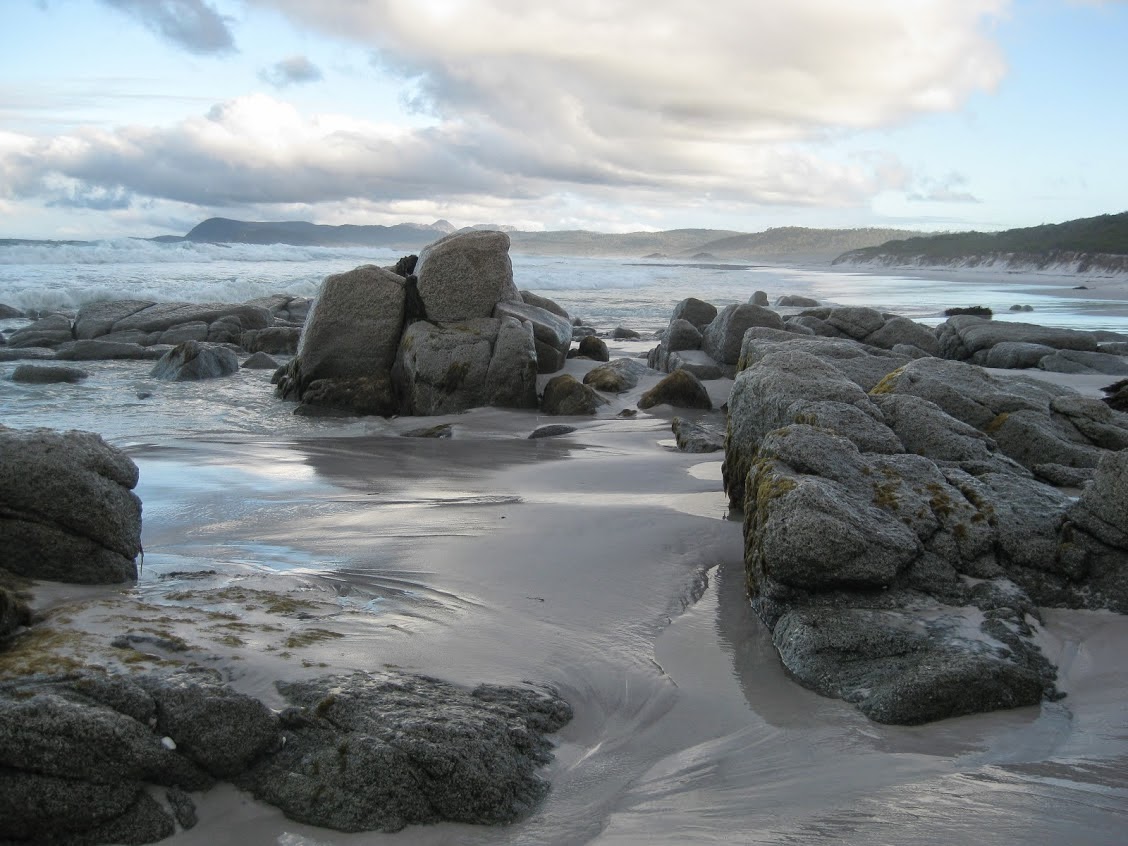
The Friendly Beaches were gorgeous, and completely empty, aside from ... us.

Don't these photos look amazing? Tasmania sprinkles magic dust upon even point-and-click cameras.

The sun sets early now that we're off daylight savings time. We made our way to our bed and breakfast in Swansea ...

... and ate dinner at a local fish and chips shop. Jonathan, who does not eat fish, ate chips. Tim, who does not eat fish, tried the meatloaf sandwich. I tried the fried flake, as well as three oysters, fresh from Oyster Bay, presumably, which is Right. There. In Swansea. My friends, it did not cost 30 dollars per plate. At less than 20 dollars per plate, it was a bargain. And someone running the shop had a strange sense of humor that I could understand.

Breakfast in the morning.

Then a quick hike around the headland in Swansea, because how could you not take the walk with that name when you are right there?

Loontitetermairrelehoiner. Say that ten times fast.
It was the last day of our vacation. We had to get back to the ferry by 6pm, and we had three hours of driving for that, at least. But it continued to be spectacular driving!

To prove to you that I took the above photo, I present the next, with Tim and Jonathan. Not photoshopped in.

We decided to see beaches on the way back. On the recommendation of Gail, our hostess at the bed and breakfast, we stopped at three different beaches.
First, Bicheno. Say BEESH - uh - no. At Bicheno, there were huge granite rocks ...

... and a blow hole.

The large waves would bounce around a crack in the granite, spewing water high and far.

We watched and climbed around for a while.
The next beach was just north of Bicheno: the abandoned white sands of Denison Beach.

Jonathan wrote in the sand. I took off my shoes and waded in the waves.

And Tim searched the beach for stuff, like this guy he found up on the sand.

Third beach: Falmouth. Recommended for shells.

And indeed, there were many shells.


From Falmouth, Tasmania (not Cornwall), we turned west, back toward Devonport. We arrived early, and so explored one last beach for an hour ...
... before checking in on the ferry.

Cabin shot.

The trip back was uneventful. The seas were calm. We slept the whole way.
Sunrise in Melbourne.

Welcome back, Real Life. *Sigh*.
At this point in our journey, reader, we had an important decision to make. Either we would spend a large part of the day at historic Port Arthur, an old penal colony and prison on the southernmost peninsula on the southernmost state in the southern country of Australia, or we would drive north and east to the ocean country near that night's bed and breakfast.
We saw a lot of convict history sites in Sydney. We opted for ocean.
But before we left, we spent a very short time in inner city Hobart, walking past the Salamanca Market (actual market is only open on Saturdays, and it was a Monday)...
... playing in the park at the edge of Battery Point ...
... and taking our picture next to this cold looking guy, Roald Amundsen, who led the first known human party to reach the south pole, in 1911. Roald Amundsen was Norwegian, not Tasmanian. But there at the tip of Hobart is an important Antarctic study center.
We decided not to bother with the GPS Karen, but just to hop on the A3 and follow it out of town and all the way to the town of Swansea, where our bed and breakfast was located. However, although Hobart, with just over 200,000 people, is not extremely large, the signs marking the way out of town are placed a little too late on the road to be very helpful. So when we knew we had missed our turnoff, we followed signs to a lookout instead, and took stunning pictures of Hobart from the other side of the river.
 |
| Hobart, under Mount Wellington. |
 |
| "Have you taken the photo yet?" |
 |
| We didn't actually stop twice at the lookout. |
First stop (after lunch at a bakery): Freycinet National Park, and a hike between the Hazard Mountains. The first overlook on the hike was towards Coles Bay to the west.
The final destination, however, overlooked Wineglass Bay to the east, toward the ocean (technically, the Tasman Sea, between Australia and New Zealand).
Jonathan was not very keen on hiking. But luckily, this was a short enough walk that everyone survived.
 |
| Survivors eating Tasmanian apples at the top. |
 |
| This bench was not actually comfortable. |
The Friendly Beaches were gorgeous, and completely empty, aside from ... us.
Don't these photos look amazing? Tasmania sprinkles magic dust upon even point-and-click cameras.
 |
| I, Artax, took this picture. |
... and ate dinner at a local fish and chips shop. Jonathan, who does not eat fish, ate chips. Tim, who does not eat fish, tried the meatloaf sandwich. I tried the fried flake, as well as three oysters, fresh from Oyster Bay, presumably, which is Right. There. In Swansea. My friends, it did not cost 30 dollars per plate. At less than 20 dollars per plate, it was a bargain. And someone running the shop had a strange sense of humor that I could understand.
Breakfast in the morning.
Then a quick hike around the headland in Swansea, because how could you not take the walk with that name when you are right there?
Loontitetermairrelehoiner. Say that ten times fast.
 |
| At Loontitetermairrelehoiner Point. |
To prove to you that I took the above photo, I present the next, with Tim and Jonathan. Not photoshopped in.
We decided to see beaches on the way back. On the recommendation of Gail, our hostess at the bed and breakfast, we stopped at three different beaches.
First, Bicheno. Say BEESH - uh - no. At Bicheno, there were huge granite rocks ...
... and a blow hole.
The large waves would bounce around a crack in the granite, spewing water high and far.
We watched and climbed around for a while.
The next beach was just north of Bicheno: the abandoned white sands of Denison Beach.
Jonathan wrote in the sand. I took off my shoes and waded in the waves.
And Tim searched the beach for stuff, like this guy he found up on the sand.
Third beach: Falmouth. Recommended for shells.
And indeed, there were many shells.
From Falmouth, Tasmania (not Cornwall), we turned west, back toward Devonport. We arrived early, and so explored one last beach for an hour ...
 |
| Devonport. |
Cabin shot.
The trip back was uneventful. The seas were calm. We slept the whole way.
Sunrise in Melbourne.
Welcome back, Real Life. *Sigh*.
Subscribe to:
Posts (Atom)